





CULTURE

A river runs through it

By Camila Pedraza

There’s something about rivers in art. Take Renoir and his boating scenes along the Seine, Monet and his sunrises over the Thames or James Butler’s views of the majestic Mississippi. Water and large quantities of it, tend to drive art: maybe this is why Colombian artist Kindi Llajtu keeps several wooden canoes in his Bogotá workshop.

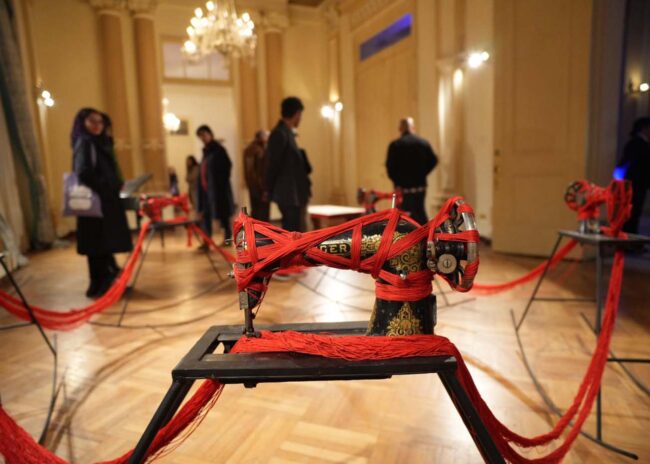
Walking through Llajtu’s recent exhibit “El Río” at Casa Ensamble, the walls and staircases of this renovated house and gallery space dissipate and colors evoke life along a mythical riverbank. Two wooden canoes hang from the ceiling, floating, but never touching, conveying the presence of a suggested river. Wound in natural fibres, nylon and string, the canoes are metaphors, hinting at the harmonious encounter of culture and the transforming nature of art. “They have experiences within them,” claims the indigenous artist.

The canoes capture Kindi’s view on art and its universal reach: “it comes from what the Ingas call ‘samay’, the inner quality of the shaman to understand others and the world, a quality that only comes from within”. Among the 18 canvases on display, zoomorphic shapes and human figures emerge from textures and carefully arranged layers of paint reveal the importance Kindi gives to exploring his rich ancestry and cultural heritage. By using a complex technique in which rough surfaces on a canvas are polished until smooth, intricate patterns emerge like embroidery on an Indian tapestry.

The use of color in Kindi’s paintings is ceremonial and like his suspended canoes, looks to unite the spirit of the sacred with the modern. Patterns and forms are a way “to delve into our identity,” he says.

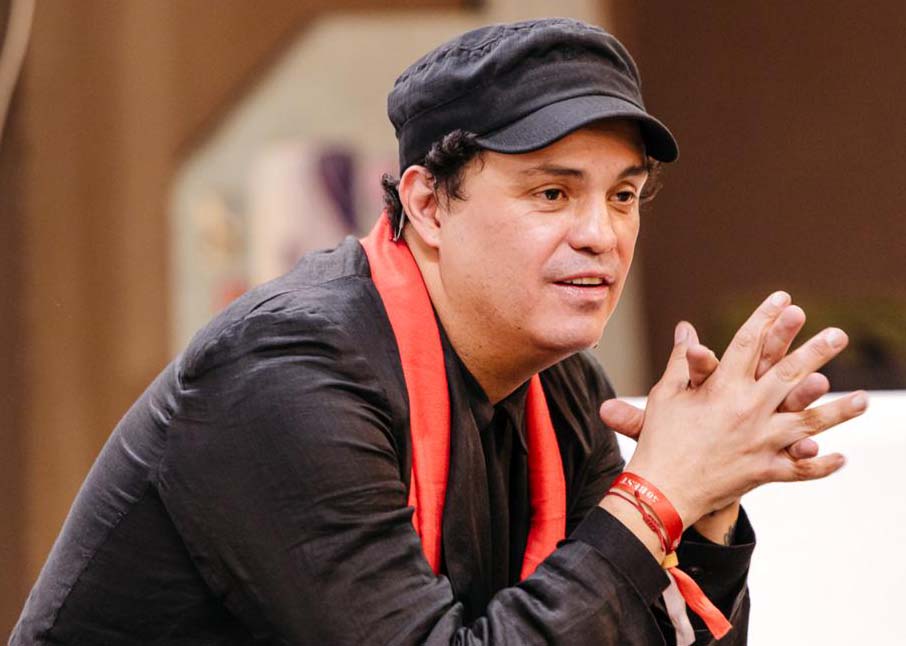
Born in 1974 under the Christian name of Vicente and in the heart of the Inga community of the Putumayo, Kindi came to Bogotá to study Fine Arts at the Universidad Nacional. As one of the few members of his community to ever acquire an academic degree, he saw a responsibility in art and was motivated to return to the Sibundoy valley. After participating in a yagé ritual with his tribe’s shaman, Vicente discovered his true Inga name: Kindi Llatju or “Hummingbird Plumage.” Transformation for this artist ismore than a creative leap: it lies at the very core of his identity.

Upon returning to Bogotá, Kindi began his career as a painter astutely aware that his artistic vein was rooted in the forests and rivers of his native Putumayo. “From an early age we are visually nurtured by the arts of the community and the nature that surrounds us: the colors of woven clothes, the intricate designs of wood carvings, the patterns

Kindi

in the feathers of birds” says Kindi, remembering his childhood influences. Images of rivers and cascades, water in it its vertical and horizontal forms, profoundly interlaced with the Inga mythology and culture, inspired him to create the series “El Rio”.

For the Inga, the river is a fertile and powerful symbol that represents life, as it takes the shape of the anaconda of their cosmological origins, but it is also a passageway to death, a connection to what is past and should not be forgotten. Using an “organic stroke,” Kindi experiments with his materials and method. From the figurative to the abstract, he feels he has found a balanced center: on one hand, shapes in the foreground convey almost childish strokes and “represent the innocent, the primordial, the sacred.” Background textures are the product of self-made brushes and the dried layers of left-over paint he peels from discarded paint-mixing buckets. These strips of paint, often torn and scratched, come to represent the layers of collective memory. Layers, which according to the artist “should not be lost”.

Not wanting to be categorized as “indigenista” with all the trapping of folklore and misguided stereotypes, Kindi believes that art and the process by which it is expressed, is indeed universal. “Sure, the work is made by a member of an indigenous group, but it is not ‘indigenista’. Though I am recovering the memory of the Inga, the viewer is recovering his own identity.”

As one approaches and interprets Kindi’s work, one enters into a play of connections. Not only to the Inga culture, but to one’s own conscious understanding of tradition and memory. For Kindi art is a bridge over a river. Linking, through water, the Ingas to the outside world, the outsiders with their memory, a universal memory.

CASA ENSAMBLE || Cra 24 No. 41-69 || Until November 6th.